This page explains laboratory work in general terms. It is not medical advice and cannot interpret anyone's test results — that belongs with a doctor or care team.
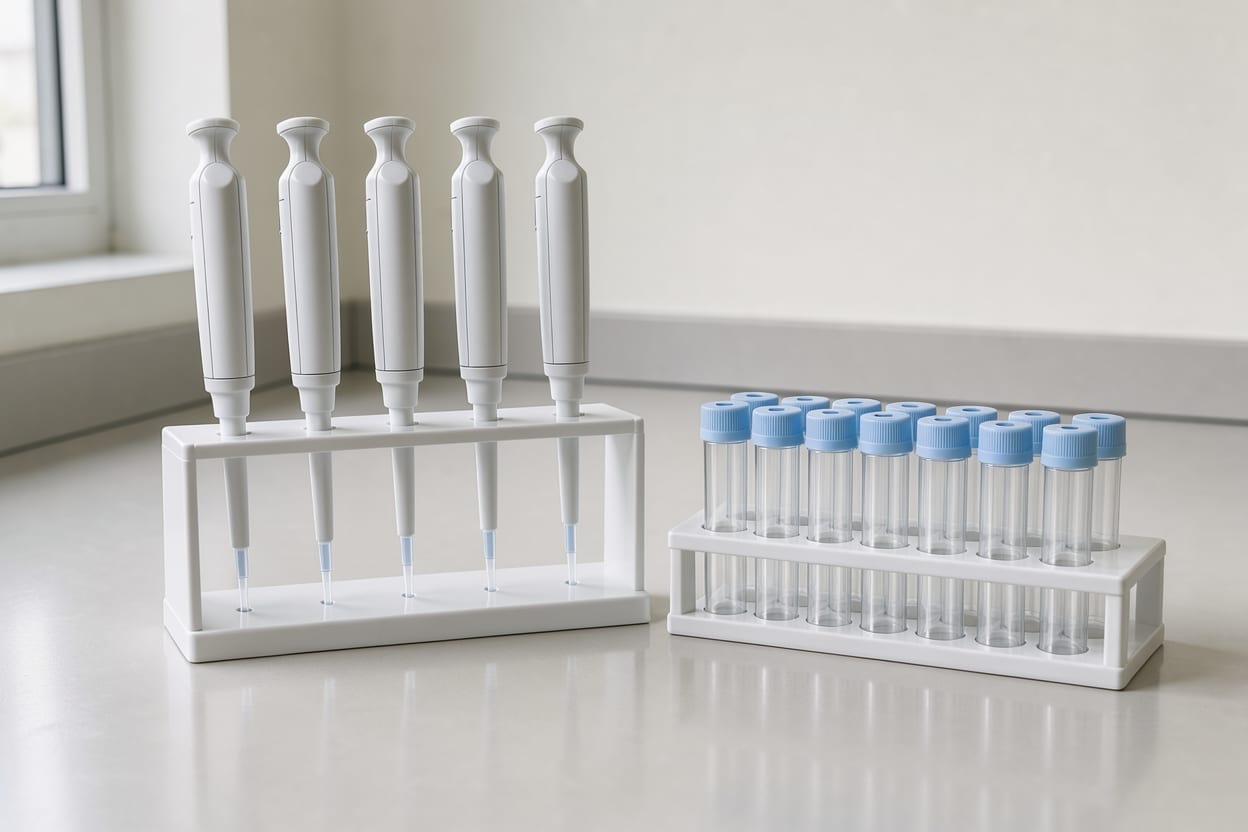
A blood sample contains cells and a fluid portion carrying proteins, hormones, salts and other substances. The laboratory chooses methods around the material and the question: counting a cell, measuring a dissolved substance and detecting a hormone involve different kinds of analysis. MedlinePlus describes blood testing in terms of those different targets. An accurate account of the work starts with what is being measured.
The sample: whole blood, plasma and serum
Blood is often collected from a vein, a process called venipuncture. The MedlinePlus collection overview distinguishes that collection from other ways of obtaining blood. What happens next depends on the test and the portion of blood it examines.
Plasma can be separated from blood collected with an anticoagulant by centrifugation. It contains proteins, electrolytes and other dissolved material, as the plasma reference explains. Serum is obtained after blood is allowed to clot and the clot and cells are removed. The serum reference explains why plasma and serum are different materials even though both are fluid portions of blood.
Blood counts describe cells and related features
A complete blood count, or CBC, measures blood-cell numbers and size, along with hemoglobin and hematocrit. Red cells carry oxygen, white cells contribute to defense against infection and disease, and platelets help clotting. MedlinePlus’s CBC guide explains these components. Hemoglobin is the oxygen-carrying protein in red cells; hematocrit describes how much of the blood consists of red cells.
A differential examines the amounts of the different white-cell types. The blood differential guide distinguishes this from a total white-cell count. A report can therefore describe both the overall cell population and its composition. Neither count alone is a complete account of health.
Chemistry panels group measurements
A basic metabolic panel includes glucose, calcium, electrolytes and kidney-related waste products. MedlinePlus’s BMP guide identifies sodium, potassium, chloride and carbon dioxide among the electrolytes and related measurements, with blood urea nitrogen and creatinine among the waste products. The panel collects several chemical observations into a named set.
The comprehensive metabolic panel adds measurements of proteins, liver-associated enzymes and bilirubin. The CMP guide describes albumin and total protein alongside these other substances. A lipid panel measures cholesterol and triglycerides, including cholesterol associated with different lipoproteins, as the cholesterol testing guide explains. A panel name identifies a group of measurements, not a diagnosis.
A glucose test measures glucose in blood. Hemoglobin A1C, often written HbA1c, examines glucose attached to hemoglobin and gives information about glucose exposure over a longer period. MedlinePlus’s glucose guide and its HbA1c guide describe the different targets. The names can appear together on a report while referring to different kinds of evidence.
Hormones are signaling molecules
Hormones carry signals between organs and tissues. They are a varied group of molecules, rather than a single substance. The hormone reference describes this signaling role. Peptide hormones are made from amino-acid chains; steroid hormones have a different chemical structure and different solubility. The peptide hormone reference distinguishes amino-acid-based hormones from steroids and describes their different interactions with cells.
Insulin and C-peptide
An insulin test measures insulin in a blood sample. MedlinePlus describes insulin testing mainly in relation to investigating low blood glucose and assessing pancreatic insulin production. It notes that this is not usually the test used to diagnose diabetes. These are clinical reasons for a request, not a recommendation for any reader.
C-peptide is produced during insulin synthesis. Its measurement supplies information about the body's own insulin production. MedlinePlus’s C-peptide guide explains that C-peptide remains in blood longer than insulin. It describes use in investigating low blood glucose and clarifying insulin production. The laboratory is measuring a related molecule with its own behavior, rather than using a different name for the same test.
Growth hormone and IGF-1
Growth hormone tests examine growth hormone production and disorders associated with it. The MedlinePlus growth hormone guide describes variation across the day and explains why assessment can involve a testing sequence or related measurements. A hormone measurement depends on its collection context as well as the method at the bench.
An IGF-1 test measures insulin-like growth factor 1 in blood. MedlinePlus’s IGF-1 guide describes its use in detecting and monitoring growth hormone disorders and notes that IGF-1 levels are more stable than growth hormone levels. This is an example of a related hormone measurement helping clinicians assess an endocrine system.
TSH and cortisol
TSH testing measures thyroid-stimulating hormone, made by the pituitary gland, and contributes information about thyroid function. The MedlinePlus TSH guide distinguishes that assessment from determining the cause of a thyroid problem. The laboratory measures the named hormone; its clinical meaning belongs to the broader assessment.
Cortisol can be measured in blood, urine or saliva. The MedlinePlus cortisol guide describes the hormone as made by the adrenal glands and the test as contributing to investigation of disorders involving cortisol production. The specimen type is part of the method description, not a detail that can be ignored.
Antibody-based methods turn binding into a signal
An immunoassay uses the recognition between an antibody and its target to detect a substance or estimate its concentration. The immunoassay reference calls the measured substance the analyte. A detectable label turns binding into a signal, which can be compared with calibrators containing known amounts of the analyte.
ELISA is an enzyme-linked immunoassay. Binding to a solid surface and the action of an enzyme can produce a measurable signal, often a color change. The ELISA reference describes adding and washing reagents in sequence. In a sandwich format, an immobilized antibody retains the target and a further antibody helps make its presence measurable.
Immunoassay formats differ in how bound and unbound materials are handled. The immunoassay format description calls methods with staged reagent addition, washing or separation heterogeneous assays. In homogeneous assays, the reagents and sample can be mixed and measured without a separation step. Labels can produce measurable radiation, a color change, fluorescence or emitted light. The label determines which signal the instrument detects; the handling format determines which components remain together during measurement. A method description therefore specifies both a binding reaction and the way its signal is obtained.
Radioimmunoassay preceded later enzyme-based formats and uses radioactive labeling. The radioimmunoassay reference and the immunoassay history describe these developments without implying that every laboratory uses the same format. Automated analyzers can perform measurements on many specimens, but qualified professionals still evaluate results, as the automated analyzer reference explains.
Mass spectrometry and peptide research
Mass spectrometry measures the mass-to-charge ratios of ions. Liquid chromatography separates components of a mixture before their mass-spectrometric analysis. The mass spectrometry reference and liquid chromatography–mass spectrometry reference explain these complementary functions. They provide a different analytical route from antibody recognition.
A 2024 review of clinical protein measurement described liquid chromatography–tandem mass spectrometry for proteins and peptides as still at an early stage of clinical application, with established methods mainly focused on research and only a limited set reaching or potentially reaching clinical practice. The review examined applications, advantages and challenges; it does not establish routine clinical testing for every peptide.
A 2021 peptidomics review examined extraction, analytical and data-analysis methods and emphasized peptide instability and the need to preserve the structure of processed peptides. Proteomics is the broader study of proteins, as the proteomics reference explains. Research methods and routine clinical measurements are related areas with different purposes.
Why a precise-looking result can mislead
A 2022 review of hormone immunoassay interference reported that interfering substances can distort a measurement in either direction and that no system is entirely free of interference. A separate 2022 practical review described a case-by-case laboratory approach when interference is suspected and emphasized collaboration between laboratory specialists and clinicians. These are limitations of analytical methods, not interpretations of an individual's result.
A 2006 paper on laboratory errors discussed mistakes before and after analysis, while a 2023 pre-analytical review described the inclusion of test selection in the pre-analytical phase. Sample handling and the clinical question remain relevant even when the final measurement is automated.
A reference range describes values found in a defined reference group. The MedlinePlus guide to laboratory results explains that ranges can differ and that a result outside a range does not by itself establish illness. A review of reference ranges likewise discusses variation between methods and populations. The range is context for clinical interpretation, not a stand-alone verdict.
The clinical departments guide places these measurements within the hospital laboratory. The comparison of scientist, technician and phlebotomist roles explains who contributes to collection, testing and reporting; the glossary defines the laboratory vocabulary.