This page explains laboratory work in general terms. It is not medical advice and cannot interpret anyone's test results — that belongs with a doctor or care team.
The contribution of a laboratory is easier to understand by following the work itself: what material arrives, which question a method addresses and what information leaves the bench. These process explanations concern categories of testing rather than particular individuals or investigations. The emphasis is on the preparations and measurements described in the sources.
A blood count during a routine checkup
The request identifies the measurement. A complete blood count, or CBC, is often included in a routine checkup. MedlinePlus describes the CBC as a group of blood tests measuring blood cells and related characteristics. The request concerns a set of measurements, not a universal answer to every question about health.
A blood specimen is collected. MedlinePlus explains blood collection . A specimen taken from a vein is obtained by venipuncture. Collection and analysis are different parts of the process; the requested test determines what the laboratory examines.
The laboratory measures cells and related features. The CBC includes red cells, white cells, platelets, hemoglobin, hematocrit and average red-cell size. The CBC guide distinguishes a total white-cell measurement from a differential that separates types of white cells. Hemoglobin is the oxygen-carrying protein in red cells; hematocrit describes the portion of whole blood made up of those cells. Average red-cell size is reported as mean corpuscular volume. Those properties differ from a cell count: the laboratory is describing the amount of a protein, the composition of whole blood and the size of a cell population, as well as counting cells.
The information returns to clinical care. MedlinePlus describes the CBC as a tool considered alongside medical history, symptoms and other information. Its explanation of the test’s limits shows why producing an accurate measurement and reaching a clinical diagnosis are different responsibilities. The blood test guide explains the measured components.
Examining a specimen for bacteria
A specimen represents the suspected site. The laboratory may receive urine, sputum or a swab. The MedlinePlus Gram stain guide describes how specimen choice follows the site being investigated. Different kinds of material can carry the question into the laboratory.
A stained slide provides an initial view. A laboratory professional examines the stained specimen under a microscope. Color and bacterial shape narrow the possibilities. The Gram stain guide explains that the stain may not establish the exact type of bacterium, so another method can be needed. In the staining procedure described by MedlinePlus, a solvent is applied after purple coloring. Some bacteria retain the purple appearance; others appear pink or red. The laboratory records these as Gram-positive or Gram-negative staining characteristics. This chemical response supplies part of the microscopic description before an exact identity is established.
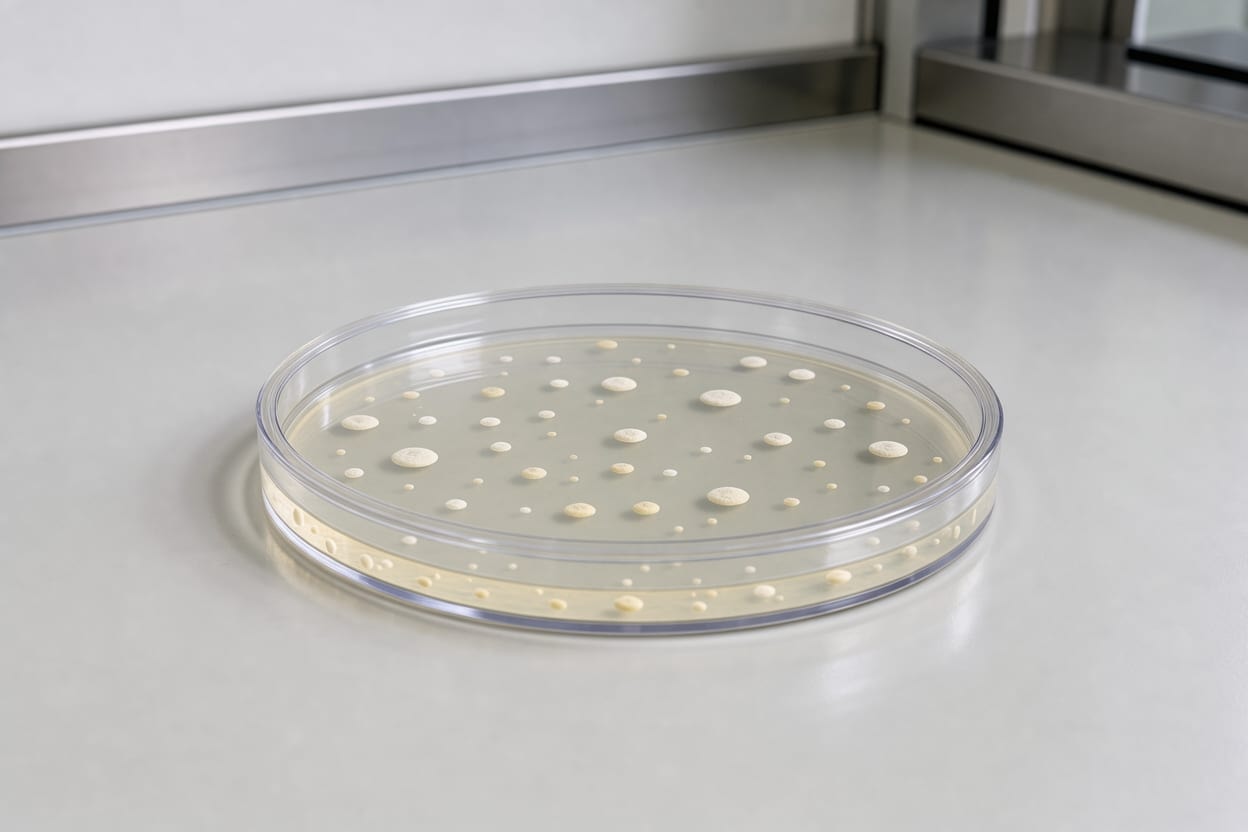
A culture grows material for identification. The specimen is placed with a medium that allows bacteria to multiply. The MedlinePlus bacterial culture guide explains that enough cells are needed to identify the organism. Growth requirements help explain why this work differs from an immediate chemical measurement.
Susceptibility work adds a different observation. An organism can be tested against antibiotics to examine its laboratory response, as MedlinePlus describes antibiotic sensitivity testing . Identification concerns what the organism is; susceptibility concerns its response under test conditions. The microbiology section of the hospital laboratory guide places these steps in their department.
A newborn blood-spot screen
Blood spots are collected on a card. NICHD describes a heel stick that supplies drops of blood for a special paper card. Its newborn screening guide explains that the dried spots are tested for congenital disorders. Hearing and heart screening use other methods and are separate from this work.
A public health laboratory screens the spots. APHL describes public health laboratory screening . Programs are organized by state or territory, and their screening panels and specimen practices vary. The laboratory's tests belong to that wider program.
The screening finding is distinguished from a diagnosis. NICHD explains that screening detects a possible problem; additional testing confirms whether a specific condition is present. This distinction describes the process without interpreting a particular result.
Follow-up connects the result with clinical work. APHL’s overview describes follow-up and referral as part of public health laboratory work. The public health laboratory guide explains how screening fits alongside surveillance and environmental testing.
Preparing blood for a transfusion
Blood typing identifies relevant antigens. The American Red Cross explains that blood groups reflect the presence or absence of particular antigens. ABO and Rh are central group systems.
Antibody findings add compatibility information. The blood type reference describes blood groups in relation to antibodies and inherited substances on red-cell surfaces. Those reactions matter because an antibody can recognize an antigen on donated red cells.
Cross-matching examines compatibility. The cross-matching reference describes mixing the intended recipient's plasma with donor red cells in a serological cross-match. The method looks for reactions indicating incompatibility. Cross-matching belongs with typing and antibody screening in pre-transfusion testing. An immediate-spin procedure centrifuges the mixture at room temperature before examination for clumping or red-cell breakdown. A fuller procedure includes incubation and the addition of anti-human globulin. The cross-matching methods description distinguishes these preparations. An electronic cross-match instead compares existing laboratory findings for the donor unit and intended recipient.
The blood bank combines the findings. A matching group label alone does not describe all the work. The cross-matching overview places compatibility testing within a sequence of checks. The blood bank guide explains blood components, compatibility work and storage as connected responsibilities.
Laboratory work in a foodborne-illness investigation
The material follows the question. Food safety laboratories may examine food products, clinical specimens and environmental samples such as water, soil or surface swabs. APHL describes food safety testing across these settings. Different samples contribute different information about a potential source.
Methods characterize hazards. APHL’s food safety overview describes detecting and characterizing foodborne hazards. It also describes molecular surveillance and sequencing and analysis methods. Characterization makes a finding more informative than a statement that a sample was tested.
Data are shared across the response. APHL describes high-quality data moving into surveillance databases and communication across disciplines involved in outbreak investigations. Its discussion of defensible data emphasizes that data need to inform public health work and be considered in the context of disease. The data also contribute to regulatory policy and action, population-based studies of illness and analysis of trends. APHL’s data-quality discussion identifies evidentiary integrity, analyte integrity and data acceptance among the subjects its resources address. That broadens the documentation task beyond recording that an instrument produced a reading: the laboratory finding has to support its intended public health use.