This page explains laboratory work in general terms. It is not medical advice and cannot interpret anyone's test results — that belongs with a doctor or care team.
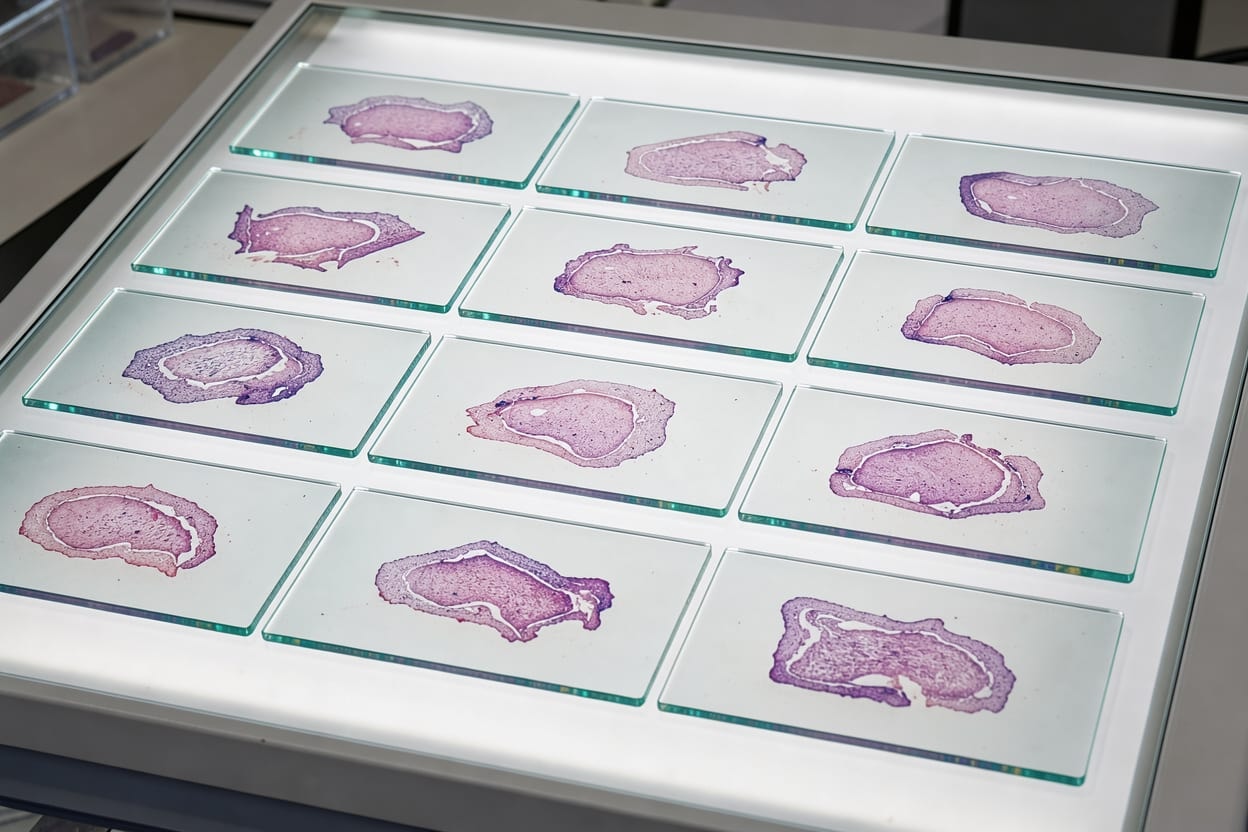
Cells and tissue provide different kinds of information. Cytology concerns cells; histology concerns the microscopic structure of tissue. The distinction becomes practical at the bench: a sample of free cells is prepared differently from a piece of tissue that needs to retain its architecture. The cytopathology reference separates free cells and tissue fragments from the whole tissues examined in histopathology.
Cytology: examining cellular detail
Cytology is the study of cells. In clinical cytopathology, the laboratory examines cells for evidence of disease. Cells may come from different body sites and may be spread on glass slides or prepared by other methods. The cytopathology reference explains that a smear is a preparation method rather than the definition of the whole field.
The cytotechnology reference describes a cytotechnologist as an allied health professional trained to examine specimens on slides using microscopes. The work includes deciding which features require closer evaluation and referring abnormal specimens to a pathologist. Looking at a slide is therefore a technical and interpretive activity, supported by preparation, records and professional communication.
O*NET's task list makes that combination concrete. It includes checking specimen information, evaluating specimen quality, examining the color, size and shape of cellular structures, and sending slides with abnormal structures to a pathologist. It also includes providing clinical data or microscopic findings for pathology reports. The O*NET cytotechnologist profile shows that reporting depends on sharing the right information, as well as recognizing visual features.
The Pap test as an example of cell examination
A Pap test examines cells collected from the cervix. The sample goes to a laboratory, where cells are checked under a microscope for abnormalities, as MedlinePlus describes the Pap smear . Its role is screening for abnormal cervical-cell changes. This explains what the laboratory examines; it does not set a screening schedule or interpret any individual finding.
The laboratory work connects a collection method with a preparation and a microscopic question. The name of the test does not describe all of cytology. Cytotechnology also includes specimens from the lung, gastrointestinal tract and body cavities, according to the reference overview. The common feature is examination at the level of cells, rather than a single organ or collection technique.
Histology: making tissue visible
Histology studies microscopic anatomy. A piece of tissue has structure that needs to remain recognizable through processing. The histology reference explains that embedding in a firm medium supports the sample and permits thin slices to be cut. Processing is part of making material suitable for observation, rather than a separate administrative step.
O*NET describes histotechnologists embedding tissue in paraffin, cutting sections with microtomes and applying stains that reveal details under a microscope. Other tasks include examining prepared slides, maintaining performance records and selecting controls for stains. The histotechnologist profile ties the visible slide to the quality of the method used to prepare it.
The histology technician profile also includes embedding, sectioning, mounting and staining tissue. It lists freezing specimens and maintaining equipment among the tasks. O*NET’s histology technician profile illustrates the shared hands-on preparation work. The profiles describe related occupations; a particular post determines how much responsibility it carries for supervision, equipment problems or specialized procedures.
Staining adds contrast because biological tissue has little natural contrast under a microscope. Some stains highlight general structure, while others target particular components. The histology reference explains staining as a way to make features visible.
From a specimen to a surgical pathology report
The National Cancer Institute’s pathology report guide describes a pathologist as a doctor with special training in identifying disease through the study of cells and tissue. A surgical pathology report records what was examined and what the pathologist found. It includes specimen information and may contain descriptions from both unaided observation and microscopy.
The same guide describes the preparation sequence for fixed tissue: stabilizing the specimen, removing water, replacing it with paraffin, embedding tissue in a block, cutting thin sections and staining slides. Its explanation of tissue examination connects the processing bench to the microscopic examination. The finished slide carries the consequences of each earlier preparation step.
A gross description can record visible features such as the size, shape and color of a specimen. A microscopic description records the appearance of stained cells and tissue, followed by the diagnostic portion of the report. The report guide explains these sections. A preparation record, a slide and a final report are related objects with different purposes.
O*NET’s pathologist profile includes writing reports, communicating findings to other physicians, examining microscopic samples and managing laboratory work. This distinguishes the physician's role from the preparation and evaluation responsibilities described for cytotechnologists and histology staff. The laboratory's work reaches the clinical team through that coordinated process.
A field with its own standards and learning
The American Society for Cytology describes itself as a collective voice for cytology. Its stated activities include developing practice standards, monitoring legislative and regulatory issues and emerging technologies, and providing professional education. These activities describe the society's field of work.
The hospital department guide places cell and tissue examination alongside chemistry, microbiology and other testing. The education routes guide explains how a course of study, practical training and credentials answer different questions about preparation for laboratory work.